

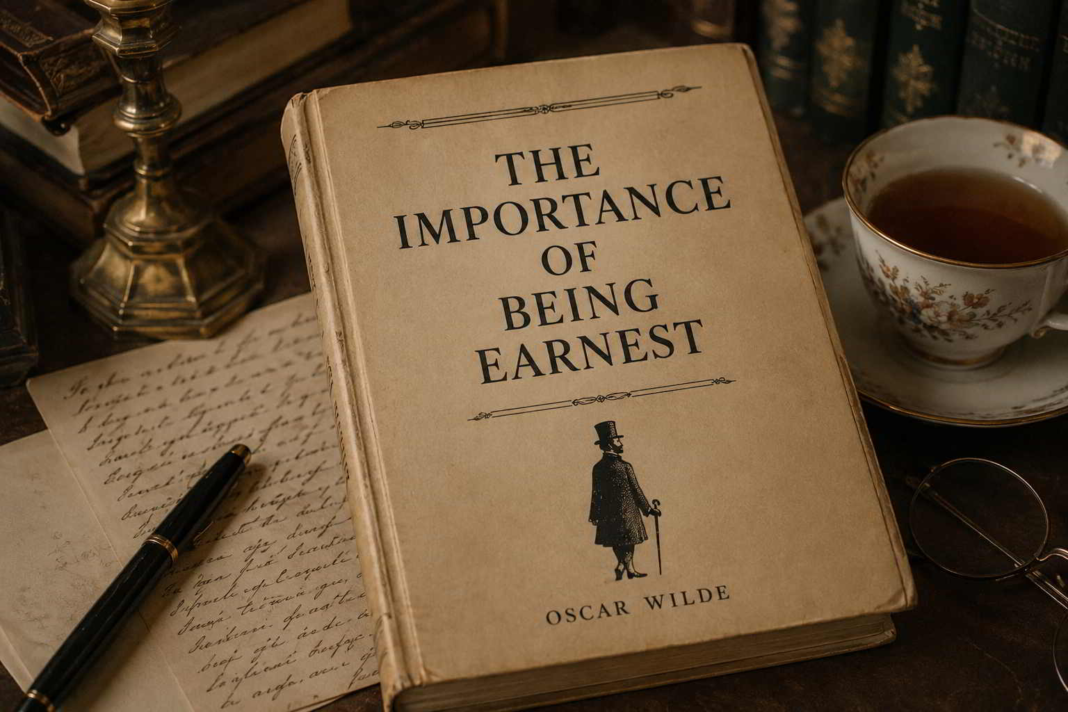

Complete pdf (searchable pdf : you can search any topic or sentence inside the book – The Importance Of Being Earnest.
The Architecture of Wit: A Definitive Literary Analysis of The Importance of Being Earnest
First performed on February 14, 1895, at the St James’s Theatre in London, Oscar Wilde’s The Importance of Being Earnest, A Trivial Comedy for Serious People stands as the high-water mark of late Victorian dramatic literature. Beneath its relentlessly sparkling surface, effortless epigrams, and absurd plot convolutions lies a calculated, surgical deconstruction of late-nineteenth-century British social institutions.
1. The Socio-Political Tapestry of Wilde’s Masterpiece
To understand why an Importance of Being Earnest analysis remains essential for modern audiences, one must examine the socio-political climate from which it emerged. Late Victorian England was caught in a deep cultural tension. On one side stood the rigid, unyielding parameters of Victorian morality—characterized by public piety, unassailable domestic duty, and strict social hierarchies. On the other side was the Aesthetic Movement, championed by Wilde himself, which argued for “art for art’s sake” and rejected the notion that art should serve a moral or socio-political purpose.
Wilde brilliantly used the conventions of the “Well-Made Play” (pièce bien faite) and traditional French farce—such as cases of mistaken identity, long-lost relatives, and highly convenient discoveries—to expose the superficiality of the ruling class. The title itself is a brilliant pun, contrasting the human virtue of being “earnest” (sincere, serious, honest) with the arbitrary social cachet of being named “Ernest.” Through this verbal play, Wilde emphasizes a profound reality about his contemporaries: they cared far more about appearance, form, and phonetics than actual integrity.
2. Character Dynamics and the Philosophy of “Bunburying”
At the heart of the play’s dramatic structure are two wealthy young gentlemen whose actions drive the plot forward.
Jack Worthing and the Illusion of Respectability
Jack represents the ultimate Victorian dual life. In Hertfordshire, where he serves as a responsible guardian to his young ward, Cecily Cardew, he adopts a serious, moral attitude to set a proper example. However, to escape these crushing expectations, he invents a scandalous, fictional younger brother named “Ernest” who constantly requires rescuing in London.
Jack’s behavior illustrates how Victorian morality forced people to live double lives. The strict demands for public respectability left no room for natural human desire, creating an environment where hypocrisy became necessary for survival.
Algernon Moncrieff and the Aesthetic Escapist
While Jack feels guilty about his double life, Algernon embraces his with complete delight. He has invented a permanent invalid friend in the country named “Bunbury,” whose sudden relapses allow Algernon to skip boring family dinners and elite social obligations at a moment’s notice.
Algernon acts as Wilde’s voice on stage, treating life as a work of art where style matters far more than substance. His absolute lack of moral guilt makes him a brilliant parody of the self-indulgent upper class.
Gwendolen Fairfax and Cecily Cardew: The Aesthetics of Romance
Wilde breaks down traditional gender roles through Gwendolen and Cecily. Both women are utterly obsessed with marrying a man named Ernest, stating explicitly that the name inspires absolute confidence. This absurd fixation turns traditional romance on its head; they do not love the men for who they are, but rather for the aesthetic appeal of their names.
3. Lady Bracknell and the Tyranny of Victorian Matriarchy
No exploration of Oscar Wilde’s Importance of Being Earnest themes is complete without looking closely at Lady Bracknell. She stands as one of the greatest satirical characters in English literature, perfectly embodying the mercenary, transactional nature of the Victorian ruling class.
When she interviews Jack to see if he is a suitable match for Gwendolen, her questions reveal a world where human emotion is completely ignored in favor of money and social status:
- On Finance: She checks his investments and income with cold precision, treating marriage like a corporate merger.
- On Politics: She looks down on education, arguing that it threatens the upper class’s position.
- On Class Origins: When Jack admits he was found in a handbag at Victoria Station, her horror highlights a system where a person’s birth matters far more than their actual character.
Through Lady Bracknell, Wilde shows that beneath the polite surface of Victorian society lay a fierce, calculating determination to protect wealth and power at all costs.
Wilde’s clever use of language relies heavily on epigrammatic inversion. By taking common cultural wisdom and flipping it—treating trivial matters with immense seriousness and serious matters with complete indifference—he forces the audience to see how absurd their own social rules really are.
4. Deconstructing the Core Themes
The Artificiality of Society
Every character in the play is performing. They speak in beautifully polished sentences and treat manners like a carefully rehearsed game. When Gwendolen and Cecily argue over tea in Act II, they use polite etiquette as a weapon, proving that good manners were often used to mask real hostility.
The Hypocrisy of Public Institutions
Wilde takes sharp aim at the pillars of Victorian society:
- The Church: Dr. Chasuble is ready to perform baptisms purely for convenience, showing a flexible approach to religion that reflects the shallow faith of the era.
- The Aristocracy: The upper classes confidently lecture others on morality while consistently dodging their own duties through their secret alter-egos.
5. The Climax and Resolving the Farce
The play’s final act brings all these absurdities to a head in the morning-room of the Manor House. The truth comes to light when Miss Prism, Cecily’s quiet governess, is confronted by Lady Bracknell. It is revealed that decades earlier, Miss Prism accidentally left her manuscript in a baby carriage and placed the infant she was caring for into a black leather handbag at Victoria Station.
That infant was Jack Worthing. This discovery proves that Jack is actually Lady Bracknell’s nephew, Algernon’s older brother, and—most ironically—that his real name has been Ernest all along.
Wilde’s ending is brilliant precisely because it avoids any real moral lesson. Jack does not learn to stop lying; instead, his lies turn out to be the literal truth. The play closes not with a lesson on honesty, but with a clever twist that rewards the deception, perfectly capping off Wilde’s masterful critique of social hypocrisy.
Frequently Asked Questions
Q1: What does “Bunburying” mean in The Importance of Being Earnest?
A: “Bunburying” is a term invented by the character Algernon Moncrieff. It refers to creating a fictional alter-ego (like his imaginary invalid friend, Mr. Bunbury) to use as an excuse to avoid tedious social obligations and escape to the country or town whenever one pleases.
Q2: How does Oscar Wilde satirize Victorian marriage?
A: Wilde satirizes marriage by presenting it as a cold business arrangement rather than a romantic union. Through Lady Bracknell’s strict interviews and Gwendolen and Cecily’s absurd obsession with the name “Ernest,” he shows a society that values money, family connections, and appearances far above love or compatibility.
Q3: What is the significance of the handbag in the play?
A: The handbag is a symbol of Jack’s lack of known ancestry and social origin. To Lady Bracknell, being born or left in a handbag at a railway station is a hilarious social failure that completely disqualifies Jack from marrying into elite society, highlighting how arbitrary class distinctions truly were.